Cranberry Lake Biological Station
Research

Cranberry Lake Biological Station has a long history as a research hub of the northwestern Adirondack region, with over 115 peer reviewed publications crediting the station. Current research programs span terrestrial and aquatic ecosystem boundaries and include work on white-throated sparrows, deer browsing, and aquatic food webs. Long-term monitoring studies on fish biodiversity and water quality are also ongoing.
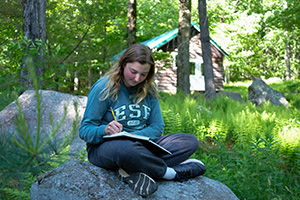
The station has the following strategic research goals:
- Grow publicly available long-term monitoring data streams across terrestrial and aquatic ecosystems.
- Engage students and trainees in the research process.
- Support internal (ESF) and external (regional, national, and global) scientists across career stages.
- Link research outcomes with local communities and resource managers.
Interested in Conducting Research at CLBS?
If you are interested in conducting research at Cranberry Lake, please complete the research interest form. After you complete the form, we will reach out to you to schedule a meeting to answer questions and discuss details.
Undergraduate Research at CLBS FAQ
Student researchers at CLBS are required to have a faculty sponsor before putting plans in place to conduct research at CLBS. The fall semester is a great time to start contacting faculty members to inquire about summer research opportunities and/or propose an independent research project. If you’re not sure where to start, have an initial conversation with your graduate TAs—they may be seeking researchers or technicians for their graduate research and often serve as co-mentors with faculty.
Academic credit is earned through the student’s faculty mentor and should be discussed in coordination with both the student’s faculty mentor and academic advisor. EFB 298 (Apprenticeship), EFB 432 (Research and Internship in Environmental Biology), and EFB 498 (Independent Research) are all possible options for applying credit to a research experience, depending on the nature of the opportunity. CLBS staff are not involved with administering or approving academic credits for research experiences, but research cannot proceed on site at CLBS without the approval of the CLBS Director.
Students should discuss funding opportunities in coordination with their research mentor. For example, faculty may have funding for student research through a variety of means. Students are encouraged to apply for their own funding with the support of a faculty mentor. Funding opportunities for undergraduate research and internship experiences may be available through CLBS Maxwell-Hanrahan Grants, ESF Career Services, NEWCOMB.
Students should complete the Research Interest Form to indicate their interest in visiting CLBS for a research project by March 15. Before filling the form, students should have already identified a faculty mentor and talked with them a general plan for research that includes what sites and infrastructure you would use, and dates you are requesting to be on Station. Please note that CLBS staff can only accommodate student researchers during our operating season (mid-May through mid-August). Students will receive a follow-up from the CLBS Director; if students have not received a follow-up email after 2 weeks of submission, they should email the CLBS Director directly (emarsena@esf.edu).
Students who are collecting vertebrate animals or stream insects on CLBS property should work with their faculty mentor to identify and apply for all necessary permits (IACUC, NYS DEC Scientific License to Collect or Possess, etc.). Permitting for individual research projects is not covered by CLBS. Students who are planning to do any research or collecting outside the boundary of CLBS are subject to policies for research on state forest and wilderness lands and should work with their faculty mentors to apply for a Temporary Revocable Permit from the NYS DEC.
By default, undergraduate researchers live in student bunkhouses. Alternative housing may be granted upon request and subject to availability. Students are subject to room and board fees to live and eat in the Dining Hall at CLBS. Rates will be posted on the CLBS website. Students needing financial support may apply for a housing fee waiver as part of the Research Interest Form.
Funding Opportunities at CLBS
Maxwell/Hanrahan Foundation
Competitive funding granted by the Maxwell/Hanrahan Foundation is available for graduate and post-doctoral researchers interested in conducting research at CLBS. Small grants may cover room and board at CLBS, research supplies, and/or researcher stipends. Applications are accepted on a rolling basis. Awards typically range from $2,000 – $4,000.
Grober Graduate Fellowship
The Dr. Samuel Grober '38 Graduate Fellowship supports the work of graduate students in the area of forest health and ecosystems research, and teaching at CLBS. To apply research must be conducted at CLBS and/or its surroundings.
Facilities at CLBS
Grober Research Lab
The lab was constructed through a generous gift from Samuel Grober ’38. It is a wet lab with bench space, a small office, a drying oven, vacuum pump, heating and stirring plates, microscopes, and fridge and freezer space.
Lodging
There are three options for lodging at the station: 1. Private 2–3-bedroom cabin with bathroom and kitchen, 2. A bedroom in a shared cabin, and 3. A private room in our lodge which consists of a shared living space and shared bathrooms.
Marina
Canoes and small motorboats are available for use by visiting researchers with permission. Docking space at the CLBS marina is also available.
Landscape
The CLBS property consists of nearly 1,000 acres on the eastern shore of Cranberry Lake plus three small islands, which together amounts to approximately 6 miles of shoreline, and a network of over 7 miles of trails with easy connections the Cranberry 50 trail circuit. Habitats represented include spruce wetland, poor fen, streams, beaver ponds, second growth forests, and historic pine plantations.